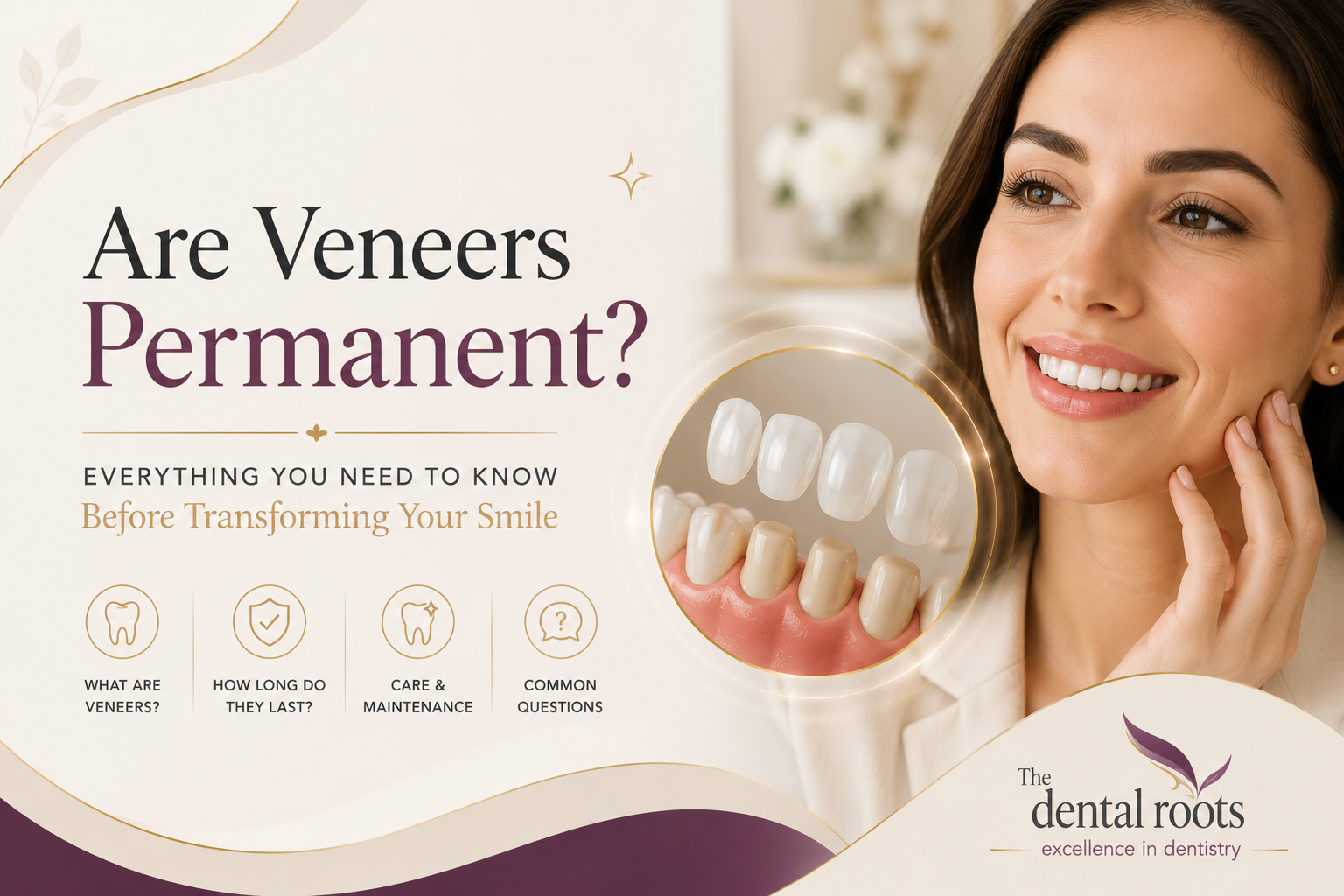
Looking in the mirror, are you fully happy with your smile? In case small cracks, deep discolored spots, or even slight gaps in your teeth make you feel uncomfortable, there are numerous possibilities of transforming your grin with cosmetic dentistry services. One of the most sought-after methods to do that at The Dental Roots includes dental veneers – ultra-thin, individually made shells that are placed on the front part of the tooth to immediately enhance its look.
But changing your smile is an important step. And the top question our patients ask us during the first consultation in our Delhi and Gurugram offices is whether veneers are permanent.
It is an important question indeed. Learning more about longevity, reversibility, and life after placing veneers on the teeth will help you become well-informed about the investment you are making. So, let’s get down to the bottom of the issue.
Are Veneers Permanent?
To properly address this question, we have to differentiate between the process of getting veneers and the restoration.
The Procedure Is Irreversible: Getting the typical veneers is irreversible since it requires enamel grinding. You have to get rid of a thin layer of your natural tooth enamel (no more than 0.5 millimeters thick) to accommodate the shell in order for it to rest flush with your gums. Since enamel does not regrow after being removed, the prepared tooth will need protection forever.
The Restorations Are Not Permanent: Do veneers last forever? No, they do not. Even though they are quite durable, any dental restoration will inevitably require replacement due to wearing out.
Therefore, although the treatment changes your natural teeth forever, the shells will still have to be replaced sometime.
How Long Do Veneers Last?
As per the information the longevity of your veneers would largely depend upon the kind of material that is used and also the way you would be able to maintain them. The life expectancy of the material in question does not wear out because of its non-degradable nature; it only depends upon the bonding surface and oral hygiene.
Here is the breakdown of what you can expect based on their clinical expertise:
1. Lifespan by Material
Porcelain Veneers: The normal duration for porcelain veneers ranges from 10 to 15 years, although in some cases, they may last as long as 20 years. The ceramic material that comprises porcelain veneers is hard-wearing and resistant to staining.
Composite Veneers: They are more delicate compared to porcelain and can be replaced after five to seven years. They have a drawback since they tend to stain from beverages such as coffee and get worn out sooner, but their strength lies in the fact that they can easily be repaired in the dentist’s chair.
2. What Causes Veneers to Fail Prematurely?
The lifespans are not definitive in any way; there are quite a few things that can make the veneers last for shorter periods of time:
Teeth grinding (bruxism): It is the topmost reason for premature veneer breakdown. The excessive force can be enough to crack the ceramic material or severely damage the composite resin.
Poor oral hygiene: In case if you develop periodontal issues or gums start receding, they will expose margins of the veneer. Also, it is possible to get cavities in the underlying dentin.
Biting hard objects: Using veneers to bite into hard objects, such as ice cubes or nails, exerts uneven and excessive force on the bonding.
The original bonding procedure: There is nothing much left to say other than the success of the original bonding plays a very big role in the durability of the veneers. If the tooth enamel was not precisely etched and prepared, there is a good chance the veneer will fall off pretty quickly.
Can Veneers Be Removed or Reversed?
Since patients might have concerns about having to make a permanent choice, some of their queries include: Can veneers be taken out? Is there any possibility of reversing dental veneers?
In theory, veneers can be removed by a dentist with the help of laser or dental burs in case they are broken or too old. But since there is a prior enamel removal step, it is impossible to just remove the veneer and get back to your normal teeth. Having your prepared tooth left unsealed will cause unbearable hot/cold sensitivity, higher risks of caries, and will look aesthetically unappealing.
If you decide to remove an old or damaged veneer, your next step will be either getting a new one or moving on to a dental crown.
A Word About “No Prep” Veneers: There are very thin veneers (Lumineers) that need little to no preparation of the enamel. In this case, the procedure might be reversible. But it is only possible to be applied to particular teeth conditions, and we at The Dental Roots can consult you during the smile designing session.
Do Veneers Wear Off or Change Over Time?
Good veneers don’t just "wear off," like layers of nail polish or tooth whitening gel that wears away. Good veneers are permanently attached to your teeth by means of dental cement.
But here’s how your veneers could be ruined through bad behavior:
Gum Recession: As we age, our gums naturally recede. If your gums pull back significantly, the margin between your natural tooth root and the edge of the veneer might become visible, requiring a veneer replacement for cosmetic reasons.
Bruxism (Teeth Grinding): Clenching or grinding your teeth at night puts immense pressure on your restorations, which can cause porcelain to fracture or composite to chip.
Accidental Trauma: Using your teeth as tools (opening fixed plastic packaging, biting your nails, chewing on ice or pen caps) can break the bond or crack the material.
The Veneer Replacement Process: What to Expect
Veneer Replacement: A Quick Overview of What You Can Anticipate
Once the time comes for you to replace your veneers, it can be done conveniently at The Dental Roots.
Assessment: The cosmetic dentist reviews the current health status of your teeth and gums.
Removal of Old Veneer: This step involves removal of the old bonding medium and shells.
New Impressions: New digital impressions are created for designing your new smile.
Bonding: Your fresh new shells are permanently bonded into place.
Tips to Maximize Your Veneer Lifespan
Although the precise engineering of your smile will be in the capable hands of your dentist, it is up to you to prolong the lifespan of your restoration. In order to do just that, remember these key steps:
Have Excellent Oral Hygiene: Brush your teeth twice a day using a nonabrasive fluoride toothpaste, and don’t forget to floss. Even though the restoration will not develop cavities, the underlying natural tissue will.
Use a Nightguard: If you tend to grind your teeth at night, our staff will provide you with a customized nightguard to protect your porcelain against excessive pressures.
Never Bite into Extremely Hard Objects: It is important that you never use your front teeth to bite into hard objects, such as hard candy or bones.
Visit Your Dentist Often: This will ensure that any potential issues, such as wear or microstructural fractures, are detected before they become more severe.
Ready to Redefine Your Smile?
While veneers might not always be permanent from a structural standpoint, the newfound confidence that comes from them surely feels like it will last forever. By opting for a professional and internationally acclaimed cosmetic dentistry group, you will have the peace of mind knowing that the small amount of enamel reduction will be done as carefully as possible.
Frequently Asked Questions
The Dental Roots Editorial Team
Written by our panel of specialist dentists & patient educators