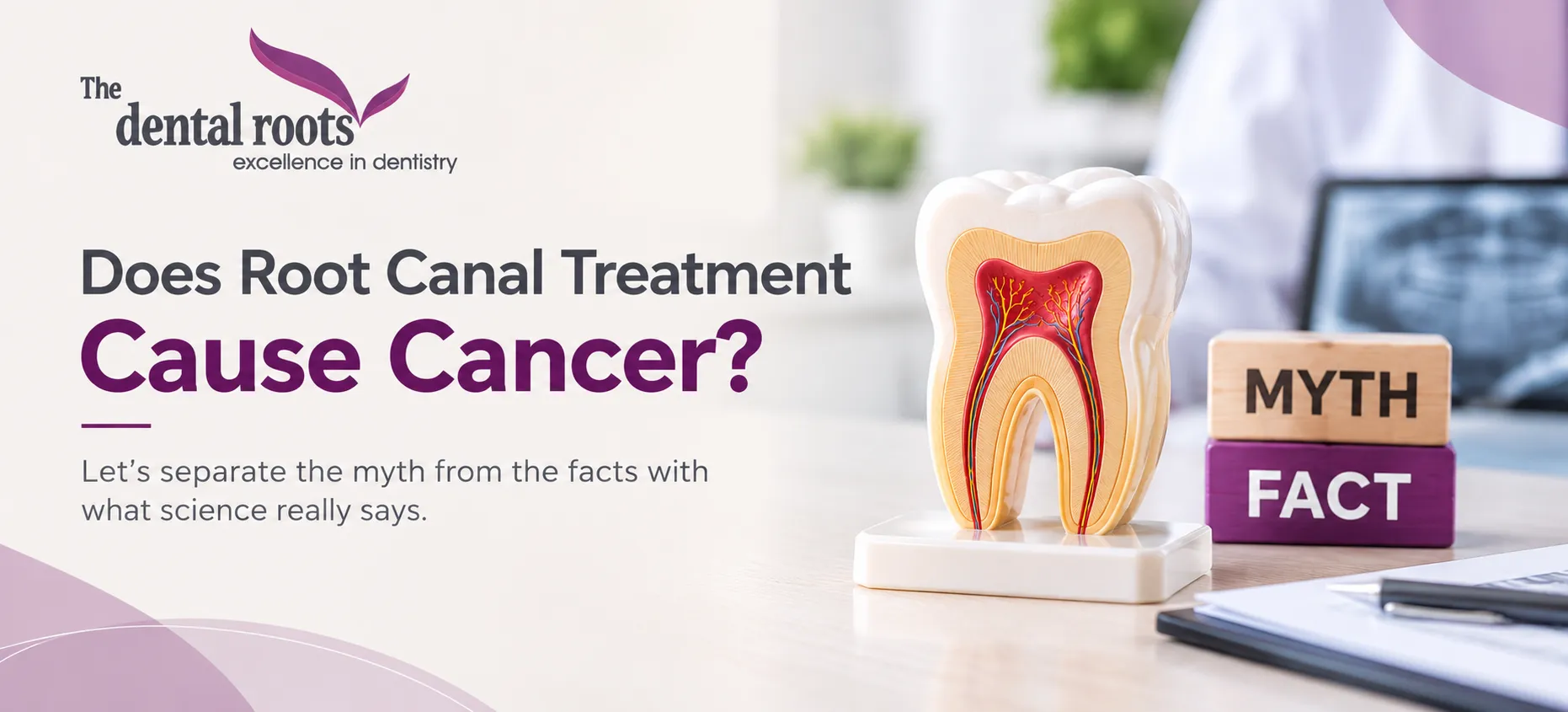
If you have searched does root canal cause cancer, you have probably come across alarming claims online, viral videos, and social media posts insisting that this common dental procedure is secretly dangerous. It is a scary idea, and it is understandable why it spreads. But when you look at what dental and medical research actually shows, the claim does not hold up. This article walks through where this myth came from, what the science actually says, and how to think about root canal safety with accurate information rather than fear.
Where the Claim That Root Canal Causes Cancer Came From
The belief that root canal causes cancer did not start with modern research. It traces back almost a century, to the 1920s, when a dentist named Weston Price developed what became known as focal infection theory. Price proposed that bacteria trapped inside root canal treated teeth could travel through the body and trigger chronic diseases elsewhere, including cancer, heart disease, and arthritis.
At the time, scientific tools for testing this idea were extremely limited. Price's studies lacked control groups, used inconsistent methods, and were conducted decades before sterile technique, modern imaging, and proper endodontic protocols existed. By the 1930s, the broader medical and dental community had already begun rejecting his conclusions, and by the 1950s, focal infection theory was considered an outdated, unsupported idea.
The theory resurfaced decades later through online wellness content and a widely criticized documentary that repeated Price's original claims without accounting for how dramatically dentistry has advanced since the 1920s. That resurgence is largely why so many people still ask can root canal treatment cause cancer today, even though the underlying theory was debunked generations ago.
What Current Scientific Evidence Actually Shows
Major dental and medical organizations, including national dental associations and health institutes, agree that there is no credible evidence supporting a causal link between root canal and cancer. Contemporary peer reviewed research has specifically looked for this connection and has not found one.
In fact, some research points in the opposite direction. Studies examining patients with a history of endodontic treatment have not shown increased cancer rates linked to the procedure itself. What untreated dental infections are actually associated with is a different kind of risk entirely, the risk of the infection spreading if it is left untreated, not the risk of it being treated.
It helps to separate two very different ideas that often get blurred together online. Systemic health can genuinely be affected by chronic, untreated dental infection, since ongoing chronic inflammation anywhere in the body is not good for overall health. But a root canal is the treatment that removes that infection, it is not the source of it. Treating an infected tooth pulp promptly through root canal treatment reduces the bacterial burden in your mouth rather than adding to it.
Root Canal Treatment and Systemic Health, Separating Fact From Fear
When people search for information on root canal treatment and systemic health, they are often really asking whether leaving bacteria in a treated tooth could quietly harm the rest of their body over time. Modern endodontic protocols are specifically designed to prevent this. The infected pulp is fully removed, the canals are cleaned and disinfected using antimicrobial solutions, and the space is sealed to prevent bacteria from recolonizing the area.
This is very different from the conditions under which focal infection theory was originally proposed, when root canal techniques were inconsistent and there was no reliable way to confirm a canal had been properly disinfected. Today's imaging and instrumentation allow dentists and endodontists to verify that the canal system has been thoroughly cleaned before it is sealed.
Root Canal Treatment Side Effects Long Term
It is fair to ask about root canal treatment side effects long term, since any medical or dental procedure deserves scrutiny. The well documented long term outcomes of root canal treatment include occasional tooth sensitivity, the need for a crown to protect the treated tooth, and in a small percentage of cases, reinfection that may require retreatment or, rarely, extraction. None of the established long term outcomes include cancer or systemic disease caused by the procedure itself.
Compare this to the alternative of leaving an infected tooth untreated. Untreated dental infections can progress to abscesses, spread to surrounding bone and soft tissue, and in rare, severe cases, become medical emergencies. From a risk standpoint, the evidence consistently points toward root canal treatment reducing risk rather than creating a new one.
Why the Myth Persists Despite the Evidence
Part of why root canal treatment causes cancer as a claim keeps resurfacing comes down to how it is framed online. Statistics like a supposed percentage of cancer patients who previously had root canals are often repeated without any published source, without a control group for comparison, and without accounting for the fact that root canals are an extremely common procedure performed on millions of people every year. When a treatment is that widespread, it will inevitably appear somewhere in the medical history of a large share of any patient population, cancer patients included, without that overlap implying cause and effect.
Genuine scientific evidence relies on controlled studies, peer review, and reproducible results. Viral claims about root canals and cancer generally rely on none of these. That distinction matters when deciding what to trust with your health decisions.
Talking to Your Endodontist About Your Concerns
If you are hesitant about a recommended root canal because of something you read online, the most useful next step is a direct conversation with your endodontist. They can walk you through exactly what modern treatment involves, how canal disinfection works, and why the procedure is considered safe by current dental health standards. A good specialist will take your concerns seriously rather than dismissing them, while also grounding the conversation in current evidence rather than decades old, discredited theories.
Conclusion
The claim that root canal treatment causes cancer traces back to a flawed, century old theory that was abandoned by mainstream dentistry and medicine long ago, yet it continues to circulate online through unsourced statistics and outdated documentaries. Current scientific evidence, including peer reviewed research, does not support a link between root canal treatment and cancer or other systemic disease. If anything, treating an infected tooth through root canal therapy reduces bacterial burden rather than increasing health risk. If you have concerns about an upcoming procedure, the most reliable path forward is a conversation with your dentist or endodontist grounded in current evidence rather than viral claims.
Schedule Your Consultation With Expert Dentists for Painless Root Canal Treatment At Dental Roots!
Frequently Asked Questions
The Dental Roots Editorial Team
Written by our panel of specialist dentists & patient educators