You have done your research; you have perused beautiful before and after pictures and are now fully ready to commit to porcelain veneers for your teeth. However, the minute you start planning everything, a giant question mark comes up and screams at you: "How many veneers will I need?"
This is definitely the question we hear more than any other at The Dental Roots. You come with a desire to change, but are not sure how many pieces of porcelain you will need to achieve that perfection.
There is no right number of pieces; everyone’s ideal number depends on his/her facial aesthetics, personal goals, and budget. We are going to explain how you can determine your number of porcelain veneers.
Understanding Your "Smile Zone"
Grab a mirror and flash a genuine, broad smile to yourself. Please don't strain while smiling; just smile as if someone tells you an average joke.
Next, count the number of teeth that can be seen by you. In some people, six teeth may be seen; in some with wider smiles, eight or even ten teeth can be seen. Dentists refer to this region as your smile zone.
The most important thing to consider while calculating the required number of veneers is your smile zone. If you have eight teeth showing up in your smile but you receive only six veneers, the other two teeth which will be present in your smile region will stick out like sore thumbs. They will appear darker and will differ in shape from your new porcelain teeth. This will result in a drop-off phenomenon in the corner of your mouth.
Can I Get Veneers for Front Teeth Only?
Quite a number of people are quite curious whether or not it is possible to keep it easy and cheap by getting just two veneers on their front teeth. Well, the answer is affirmative since having veneers applied to the front teeth only is quite common practice which has a particular purpose.
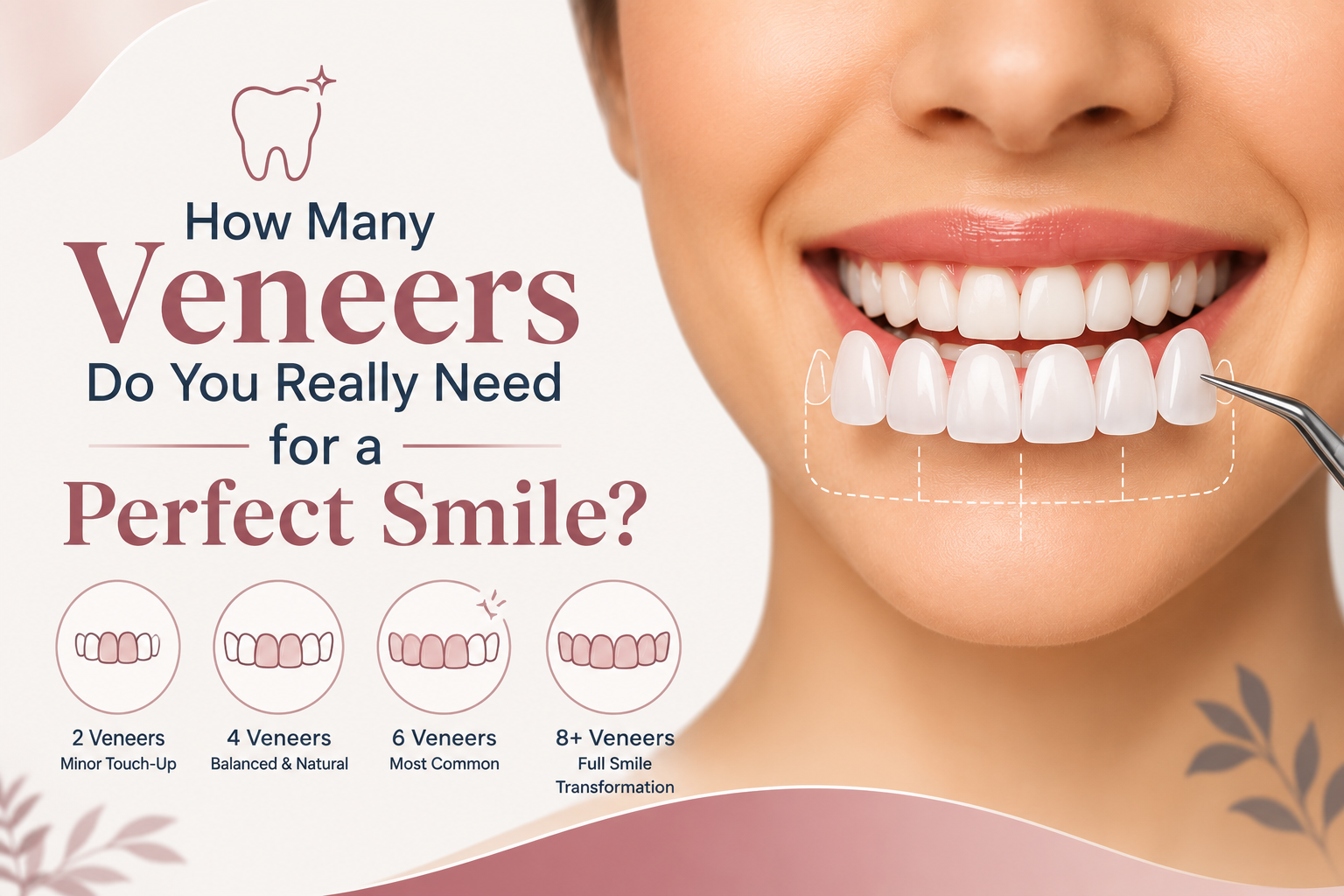
Typically, a person who wishes to get just one, two or four veneers wants to solve a certain problem, and not transform the whole smile of a person. It could be that you broke one of your front incisors playing some sport, or maybe you have diastema (a space between your teeth). Provided that all your other teeth are straight and healthy, and the patient is satisfied with the teeth coloring, an experienced dentist will be able to make several veneers which will match perfectly your natural enamel.
There is a trick though; if you decide to apply veneers to just a few teeth, your teeth will stay the same color as your natural teeth are now. There is no chance to choose Hollywood white for your front teeth if your other teeth are off-white.
.
How many veneers do we need : 6 vs 8 vs 10 Veneers ?
When patients want a true transformation—changing the color, shape, and overall symmetry of their smile—we start talking about bigger numbers. If you are wondering how many teeth need veneers for smile makeover, the conversation almost always lands on the upper arch.
Why the upper teeth? Because they take center stage. When you talk and smile, your upper teeth catch the light, while the lower teeth generally sit in the shadows of your lower lip. As a result, upper teeth veneers are the standard starting point.
Here is how the classic numbers break down:
6 Veneers:
This covers your central incisors, lateral incisors, and your two canines. For people with narrower smiles, six is sometimes enough to cover the visible smile zone. However, six veneers can sometimes leave the premolars (the teeth just behind the canines) looking dark in the corners of your mouth.
8 Veneers:
This is widely considered the sweet spot for a standard smile makeover. By placing eight veneers, the dentist covers everything from the front teeth all the way back to the first premolars. When you look at the debate of 6 vs 8 vs 10 veneers, eight usually wins for the average adult. It gives a wide, bright, cohesive look that fills out the corners of the mouth beautifully.
10 to 12 Veneers:
If you have a very broad, expansive smile, you might show your second premolars or even your first molars. To get that seamless, red-carpet look without any dark spaces at the edges of your mouth, ten or twelve veneers across the top arch are required.
What About the Bottom Teeth? (Veneers for Full Smile)
While the top teeth are the most prominent, there are also those who want a complete transformation. For a complete smile makeover using veneers requires attaching porcelain to both sets of arches at the same time.
You will have to go for lower veneers if your lower teeth are too crowded, very stained, or even badly worn out due to continuous grinding. This way you can be assured that both shape, length, and bright white appearance are always in perfect harmony whenever you speak or laugh out loud.
Obviously, this raises concerns regarding the amount of money to be spent on such treatment. As expected, the cost of full mouth veneers is quite high since you are effectively doing twice the work. It involves anywhere between 16 to 20 veneers altogether. Despite the high cost, the outcome is definitely worth it.
The Importance of Proper Treatment Planning
No one ever needs to figure out their perfect number alone. Working out how many is going to be an effort shared by you and your dental professional.
At The Dental Roots, we feel that outstanding outcomes require diligent treatment planning. At your cosmetic consultation appointment, we’re not just looking at your teeth, but we’re looking at the symmetry of your face, your lip movement, your gum line, and the shape of your arches.
We take a series of pictures and sometimes make use of digital smile design software, which means that we’re able to plan out the design of your future smile without ever even touching your teeth. In this process, we’re able to point out to you the visual differences between having six, eight, or ten veneers.
Frequently Asked Questions
The Dental Roots Editorial Team
Written by our panel of specialist dentists & patient educators