For anyone who has suffered the shock of having an extremely painful toothache, they will tell you that it is a unique experience of pain. This kind of pain wakes you from a peaceful slumber, interrupts your work schedule and makes it impossible to enjoy your favorite foods. When the pain strikes, the main concern for anyone is looking for ways to alleviate it. But while waiting to sit down at the dentist's office, the first thing that comes into mind is what caused the problem.
If you are currently experiencing a jaw rub and reading about what causes tooth infections, then you are on the right path to solving the mystery. To effectively take care of your dental health, one has to move past the idea of protecting just the surfaces of the teeth. For instance, when most people think of their teeth, they see them as strong and tough bones.
In today's world, the specialists of The Dental Roots are working on decoding the mechanism of toothache. We shall see what the major causes for a tooth infection are and how our everyday activities, which seem trivial enough, can cause such damage to the structure of the teeth.
The Anatomy of the Attack: Understanding Pulpitis
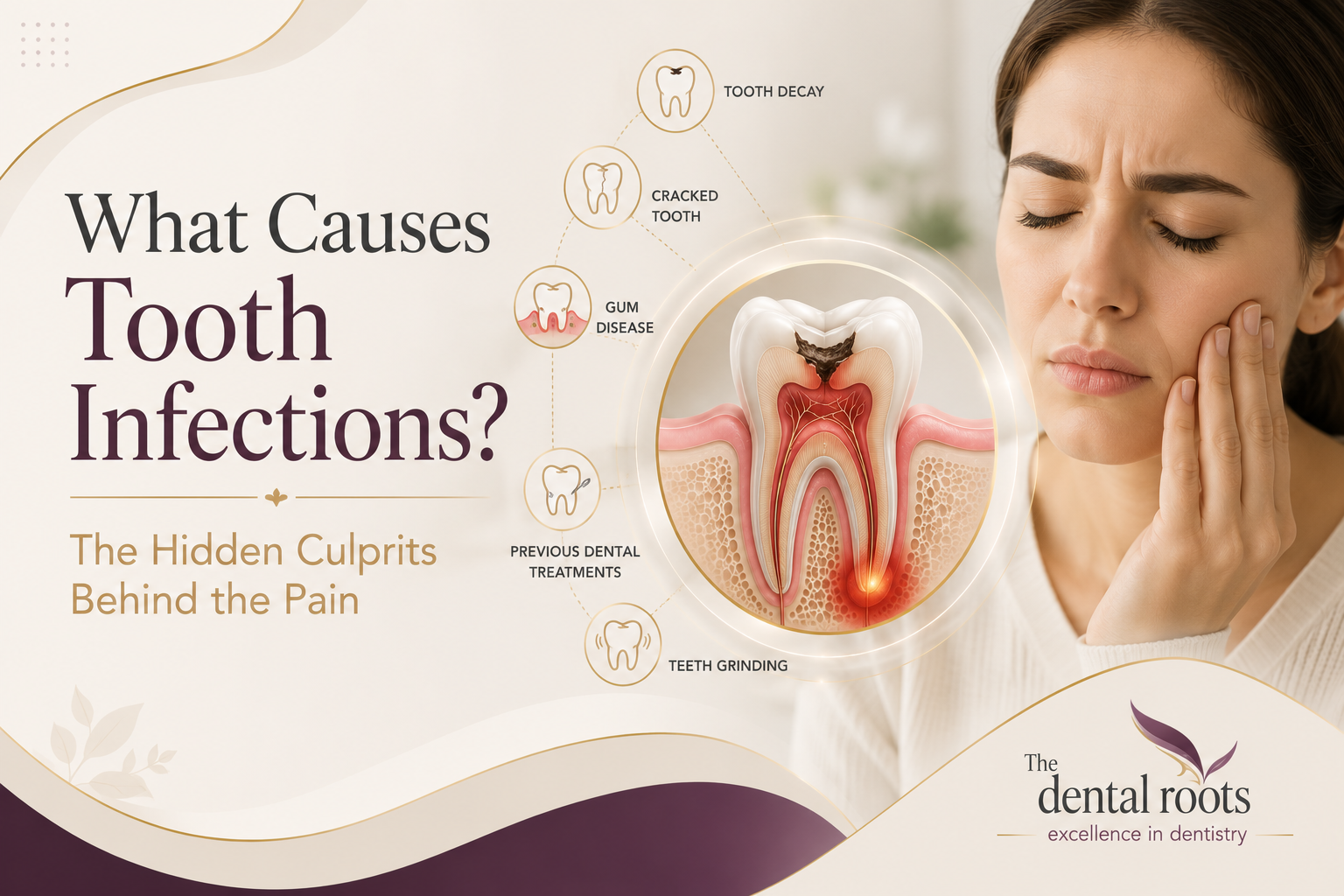
In order to understand the mechanics behind an infection, one must analyze the structure of the tooth in question. The hard, white part that is visible above the gumline is called enamel. Below that lies a soft, porous material called dentin. Finally, the interior of the tooth itself is hollow and consists of living tissue called dental pulp.
Enamel protects the sterile dental pulp from contact with anything from the outside world. Once the vault of enamel is damaged, the oral bacteria are able to access the interior part of the tooth and infect it. The reaction to such intrusion is called inflammation and it is extremely painful.
Pulpitis is the name given to this type of inflammation in dentistry. When it comes to causes of pulpitis, the most common cause is the actual presence of bacteria in contact with the exposed living tissue. Since the inflamed area of the tissue is surrounded by the dentin, which is completely rigid, there is nowhere for the increased pressure to go but into the living tissue itself.
1: The Slow Burn of Untreated Tooth Decay
As we examine some of the most common causes of a bacterial tooth infection, tooth decay surely ranks at number one. It is a slow, progressive condition that goes unnoticed by many until it reaches an advanced stage.
Every time that you eat anything especially if it is food containing sugar and simple carbohydrates a feeding frenzy starts up inside your mouth courtesy of the bacteria residing there. As they feed on the residual sugar left on your teeth, they release very acid material. If this acid material is not rinsed off from your teeth, it starts to wear down the outer enamel coating of your teeth in order to form a cavity.
The earliest sign of tooth decay is usually pain sensitivity, and if the cavity is detected at this stage, then all that needs to happen is for the hole to be filled in. But when you ignore the symptoms and allow the bacteria to continue eating away at the enamel, they will finally burrow their way past the dentin and open up a pathway straight to the pulp chamber.
2: Hidden Cracks and Dental Trauma
A mouthful of cavities is not the only prerequisite for acquiring a serious internal tooth infection.
For example, you could simply be chewing on some frozen ice when suddenly the chunk breaks off; you could bite down on a hard popcorn kernel by accident; you could get hit in the mouth while playing basketball on the weekends. In spite of the fact that your tooth will probably not break apart into pieces, the physical impact will leave hairline fractures on your teeth’s enamel.
In addition, there are many cases when adults unknowingly grind their teeth while sleeping; the condition is called bruxism. Due to years of grinding, your teeth suffer a lot from the pressure and end up cracking due to the enormous pressure. The cracks become doors which will let microscopic bacteria enter the tooth even though the cracks are invisible to the eye. The bacteria travel down the cracks and enter the tooth pulp without touching the enamel.
3: The Danger of Gum Disease
While we usually consider tooth infections to be a top-down process, starting from the surface of the tooth and spreading into the interior part of the tooth, there may be infections that can affect your tooth in the bottom-up fashion.
Periodontal disease is the name of an extremely serious condition involving the infection of your tooth supporting soft tissues and bones. If you allow plaque and tartar build-ups along your gum line, your gums will become irritated and start pulling away from the teeth, creating deep infected pockets along the gum tissue and the tooth root.
With the deepening of the periodontal pockets, the bacteria may spread throughout the side of the tooth root, reaching a small hole at the very end of the tooth, where the blood vessels enter the tooth. Therefore, the bacteria from the gum infection may actually get inside the tooth through this bottom hole.
4: The Impact of Daily Habits
Ultimately, almost all of these issues trace back to your daily routine. A poor oral hygiene tooth infection is the direct result of neglecting the basic maintenance your mouth requires to stay healthy.
Excellent dental hygiene is your first and most important line of defense. When you skip brushing before bed, or when you decide that flossing takes too much time, you are allowing a sticky film of bacterial plaque to permanently harden onto your enamel. Over weeks and months, this uninterrupted bacterial growth significantly increases your risk of deep decay and gum inflammation. Maintaining a strict, twice-daily routine disrupts these bacterial colonies before they have a chance to deal permanent structural damage to your smile.
What Causes Dental Abscess?
If a pulp infection is not treated, this will rapidly lead to a dental emergency. You might want to know what causes dental abscess, which is among the most serious and painful problems you might encounter when your tooth remains untreated.
Once the bacteria completely take over and destroy the nerve inside the pulp chamber, the infection proceeds to move down from there and goes through the root canals and comes out of the end of the tooth root into the jawbone. Having no place left to go, the infection gets walled in by the body, forming a small pus pocket in the bone and gum tissue.
This is what a dental abscess looks like. This condition appears as a pimple on the gums that surround the infected tooth, and usually causes swelling and tenderness in the face, fever, and sour taste in the mouth, if the abscess starts to discharge pus. The abscess can be very dangerous, since it is easy for the aggressive bacteria to penetrate into the bloodstream or even the neck and brain.
Reclaiming Your Health at The Dental Roots
It is essential to understand that there are no self-healing infections. While your body may be able to recover from cuts and scrapes or a common cold, it will not be able to regrow destroyed tooth enamel or treat an infected dental pulp without any additional help.
If you have the symptoms of an infection, a painful throbbing or sensitivity to temperatures, or facial swelling, it is high time to do something about it. At The Dental Roots, we have a very specialized team of dentists who will help you get rid of your pain and save your natural smile. Our top-of-the-line facilities in New Delhi and Gurgaon use 3D imaging and microscopic endodontic techniques in order to locate the problem area and treat it properly.
Regardless of what procedure you need a regular protective filling or a complicated root canal treatment for your deep dental pulp infection, or even some advanced periodontal treatment, we offer you the most comfortable experience. Let us make sure your dental problems do not become serious enough to put your health at risk. Contact us now and let us help you keep your healthy smile!
Frequently Asked Questions
The Dental Roots Editorial Team
Written by our panel of specialist dentists & patient educators