What Foods To Avoid After Getting Veneers: Your Ultimate Guide to Protecting Your Smile
Having a smile makeover is one of the most exciting experiences ever. After all, you will be able to stand in front of a mirror and appreciate your perfect, white, and symmetrical teeth that you always wanted. But after a couple of hours after having left the dental chair, something changes you get hungry. You grab a plate, start eating, and then stop suddenly. Wait a minute, can I really bite into this? Will not this cause any damage to my newly acquired teeth?
In case you started thinking too much before every bite, remember that such feelings are totally normal. After all, you invested both time and money in your new appearance, and you definitely do not want to tell your dentist that an impudent pistachio destroyed it.
Fortunately, you do not have to spend the rest of your life eating only liquid food. But there are still some things you should know. Here is what you need to learn about the ultimate diet after getting veneers so that you can easily answer the question whether you can eat normally with veneers.
Phase One: Surviving the Temporary Veneers
But before I tell you about your brand-new porcelain smile, I want to briefly discuss your transitional smile. Your dentist will apply temporary acrylic covers on your teeth until your porcelain veneers are fabricated in the laboratory.
These temporaries were designed to be short-term covers, which means they were made from poor-quality material and are attached to your teeth with temporary cement that can be removed without any issues in a couple of weeks' time. That is why the restrictions you have to follow at this stage are pretty strict.
While you have temporary covers on your teeth, you should only have soft foods. It means pasta, mashed potatoes, soft fish, scrambled eggs, smoothies – everything you can chew with your tongue. Any crusty, sticky, or hard foods are absolutely forbidden, since a single bite of a crusty baguette or a taffy can just rip your temporaries right off. Also, you need to watch out for any highly colored foods and drinks – as acrylic is very porous, your temporaries will become stained quickly.
Phase Two: The Permanent Veneers
Once your custom porcelain shells have been securely adhered to your natural teeth, the stakes shift. Porcelain that dentists use for this procedure is extremely strong. This is the very reason why most people choose this particular method over dental bonding.
So, can you eat anything you want? Yes, for the most part. You can return to your regular diet, eating as usual, and going on with your daily routine without any worries. Just like with the word "anything," "regular" is relative in this case. Although porcelain is indeed a strong material, it is not invincible.
It is, however, brittle, and therefore it has relatively low tensile strength but high compressive strength. There are certain food types that you need to avoid post-veneers for decades of beautiful smile to follow.
The Core List: What Not to Eat With Veneers
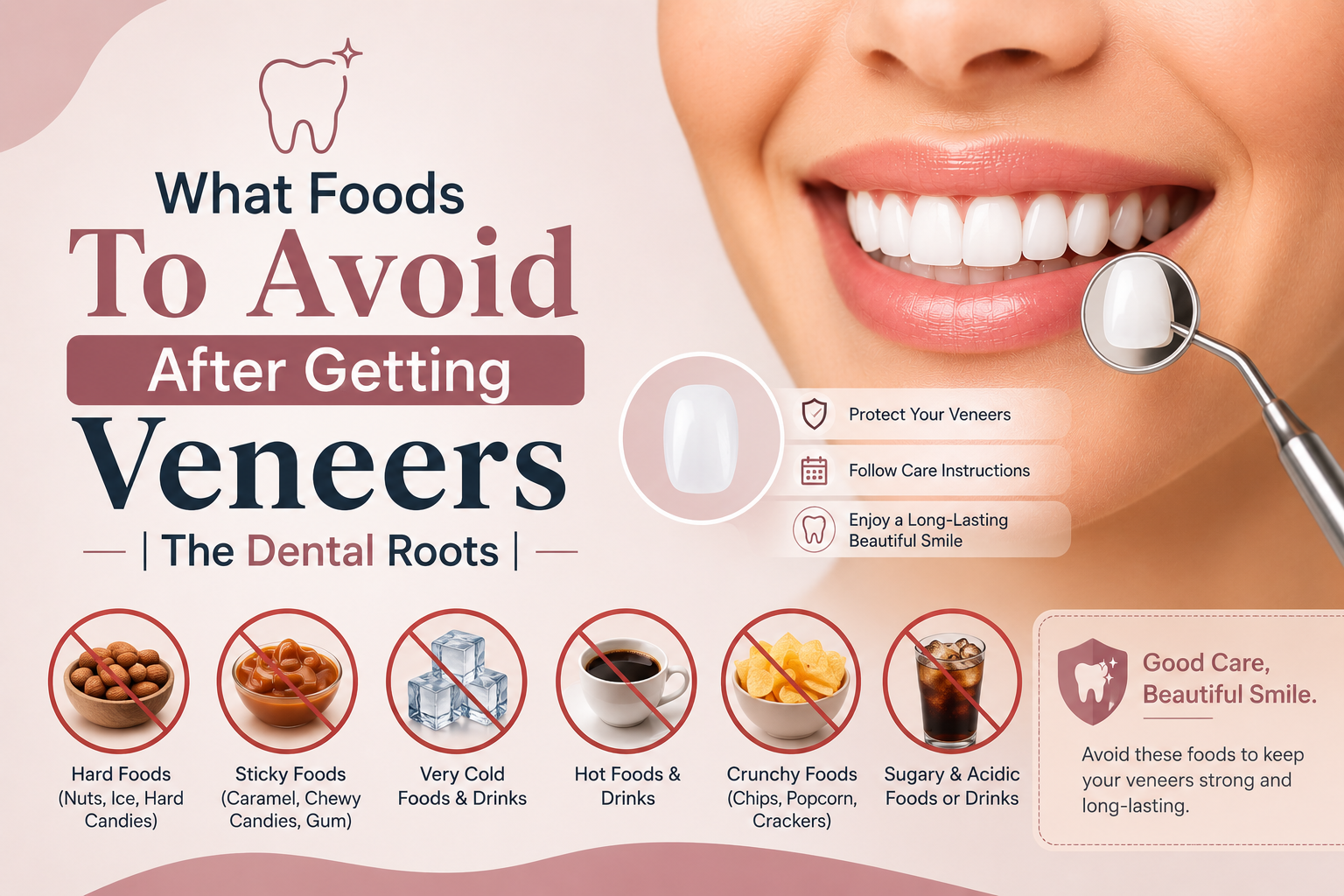
1. Proceed with Caution: Hard Foods and Veneers
When we look at the biggest threats to cosmetic dental work, hard foods sit at the very top of the list. Biting down on something completely rigid puts intense, focused pressure on a tiny area of the porcelain, which can cause micro-fractures or actual chips.
Ice Chewing: This is a massive issue. Ice is a crystal, and dental porcelain is a crystalline structure. When two incredibly hard, rigid structures grind against each other, one of them has to give. Often, the veneer loses that battle. Ice chewing is a habit you must break immediately.
Hard Candy & Nuts: Biting down on a jawbreaker, a lollipop, or uncracked nuts (like almonds or pistachios) with your front teeth is a recipe for disaster. If you want to eat nuts, choose softer varieties like walnuts, or ensure you are chewing them exclusively with your back molars.
Popcorn: The popcorn itself is fine, but those unpopped kernels hiding at the bottom of the bowl are notorious for cracking both veneers and natural teeth.
2. The Mechanics of Eating Raw Produce
It is not necessary to stop having healthy snacks; however, it is mandatory that you start changing how you consume them.
Consider how you consume an apple or a large carrot. The first thing you do is bite onto it using your front teeth, then move your hands forward to break off a piece. The movement of moving forward causes excessive pressure to be exerted on the back of your front teeth. This is precisely the kind of pressure that will dislodge your veneers.
Simply avoid biting on apples, carrots, or corn on the cob and use a knife to break down the food. Break your apple into wedges, your carrots into coins, and the corn off its cob. You will be able to chew using your back teeth while protecting your front teeth with the veneers.
3. Sticky and Chewy Culprits
Candies that have a sticky consistency such as caramels, taffy, gummy bears and some extra-chewy protein bars should be avoided. Although today’s dental bonding is exceptionally powerful, the act of continuously chewing on sticky materials causes a sucking action. This sucking action over time can result in the weakening of the bond of the veneer’s margin.
4. Tough, Tearable Meats
Just like eating raw apples, chewing meat is quite difficult, and you need to take lots of bites and pulls in order to be able to eat the meat. Chewing on meat straight from the bone, such as ribs and chicken wings, or attempting to cut through a tough piece of beef jerky with your front teeth places additional pressure on the porcelain.
The Sneaky Issue: Staining Foods and Beverages
One of the best aspects about fine porcelain is that it does not get stained easily. Porcelain is made with a stain-resistant, glass-like coating, unlike natural enamel that behaves more like a sponge to stains.
It is important that you watch out for potential staining foods. The reason for this is that composite resin cement may get stained by dark pigments from foods after some time. Constant exposure to dark foods may lead to a brown or yellow stain forming at the margins of the porcelain veneer.
This should not be a cause to stop consuming black coffee, red wine, dark soda drinks, or foods such as turmeric and blackberries entirely. Simply practice better habits. Sip your iced coffee using a reusable straw to avoid staining your front teeth. Rinse your mouth with water after consuming a drink of red wine or eating blackberries.
Essential Veneer Care Tips for Long-Term Success
Diet is half the challenge. Maintenance of veneers calls for excellent oral care habits and some minor changes in lifestyle.
Start with examining your toothpaste. All toothpaste products labeled "whitening" should be disposed of, along with those containing baking soda or charcoal, as these are highly abrasive. Though they effectively remove stains from natural teeth, they have the same effect as sandpaper does on porcelain. Abrasive toothpaste will eventually damage your veneers by scratching their protective layer and thus making them look dull and extremely prone to stains. Replace your whitening paste with a non-abrasive gel and a toothbrush with soft bristles.
Second, your teeth are not instruments. Do not employ your veneered teeth for tearing packages, biting nails, holding pens, or cutting off clothing labels that causes a lot of stress to the thin edges of porcelain.
Lastly, if you have pain in your jaw in the morning, you may suffer from bruxism grinding of teeth while sleeping. The pressure exerted unconsciously is enormous.
Tell your dentist right away so they can fit you for a custom night guard. Wearing a night guard is the single best insurance policy for protecting your cosmetic investment while you sleep.
Why Choose The Dental Roots for Your Smile Makeover?
Your veneers will be as good as the dentist placing them. The longevity of your brand-new smile depends greatly on careful tooth preparation, excellent bonding materials, and proper fit.
When it comes to cosmetic dentistry at The Dental Roots, we know it's a combination of engineering and artistry. Our ceramics are the best in the business – they’re very strong and at the same time not heavy and unattractive. And when you choose The Dental Roots to place your veneers, we are not going to simply put them on and tell you to come back in a year – we teach you how to take care of them so that they will look as beautiful as ever ten years later.
Frequently Asked Questions (FAQs)
1. Can I still drink hot coffee with veneers?
Of course, yes. Your porcelain is very strong when it comes to temperature change and your coffee will not affect it in any way. Just bear in mind that although it does not get stained very easy, it would still be best to drink some water after you finish your coffee.
2. Is it safe to chew gum if I have veneers?
Usually, there is no problem chewing sugarless gum with porcelain veneers because they are very strongly bonded. But during the temporary period, you have to stop using any kind of gum because it will displace the acrylic covers.
3. Can I eat steak and other meats?
Yes, you can definitely have your steak too. You just need to make sure that you cut the meat up into manageable portions and chew the same with your back teeth. You shouldn't attempt to tear off a piece of meat using your front teeth.
4. What should I do if a veneer accidentally chips while eating?
Do not panic. Even though this rarely happens, it is possible if you crunch your teeth on an unnoticed bone or kernel. Keep the fragment of porcelain if you manage to find it and inform us at The Dental Roots straightaway. Do not attempt to put it back in place by yourself. It will depend on the size of the fracture whether the veneer needs polishing, repairing, or replacement.
5. Do I need to floss differently around veneers?
Flossing should be done just like you do with natural teeth once daily at the very least. You cannot possibly damage a well-bonded veneer by flossing. Actually, flossing regularly for great gums is essential in order to ensure that your gums remain healthy and do not recede, thus revealing the veneers.
The Dental Roots Editorial Team
Written by our panel of specialist dentists & patient educators