
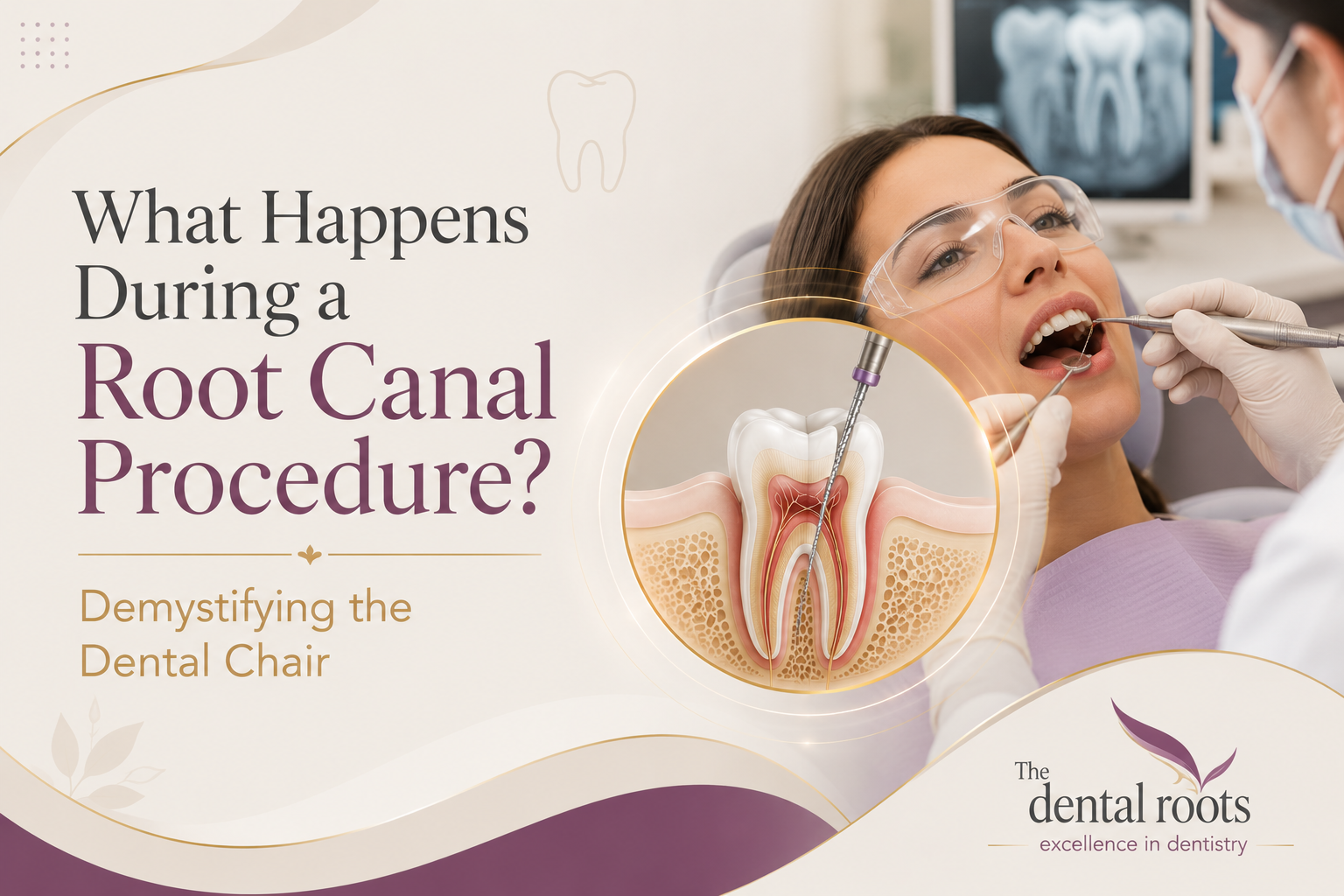
Let us be completely frank—the thought of sitting in a dentist's waiting room and preparing for a major procedure can be quite terrifying. You are bound to have wild thoughts running through your head about worst case scenarios and the scary tools a dentist can use on you. Knowing that you will need endodontic treatment because you are suffering from a severely infected tooth can cause even more anxiety than the procedure itself.
Knowledge is the key weapon in your arsenal against dental anxiety. Right now, if you are in pain due to your tooth and are curious about how root canal procedure is done, you are on the right track. Learning about the root canal procedure step by step can give you the knowledge and confidence that you need.
Modern day technology has advanced to make root canal procedure almost flawless. In order to get rid of your dental anxiety, we will tell you about each step involved in the procedure from the moment you sit in the chair until you are finally out and feeling fine.
Setting the Stage: Why Are We Doing This?
Before we move on to the practical aspect of the procedure, you must understand what the dentist needs to do. Each tooth contains a hollow area called the pulp chamber. Inside there, you will find the live part of the tooth, complete with nerve endings and little blood vessels.
When a deep cavity left unchecked for too long or a crack in the hard enamel caused by some injury allows bacteria present in your saliva to get into the chamber, the infection spreads through the tissue. Since it is trapped in a hard bone casing, the infection results in that excruciating throbbing pain that prevents you from sleeping. That is all the procedure is about getting rid of the infected tissue and cleaning the chamber.
Stage 1: Precise Diagnosis and Preparation
The initial stage of root canal treatment involves preparation only. Neither your dentist nor an endodontist specialist will even think about doing anything until he sees an exact map of your tooth.
First of all, your dentist will take digital X-ray photos. This will help him understand the exact condition of the roots canals and how deep the infection reached in relation to the surrounding jawbone.
After that, comes the crucial step in terms of making you feel comfortable. The dentist will use topical anesthesia gel and a strong local anesthesia on the gums. In just a couple of minutes you will have all the area feeling numb and sleepy. You will be conscious but won't feel any pain. In order to isolate the tooth and avoid saliva contamination of the sterile environment, the dentist will cover the affected tooth with a protective sheet – a rubber dam.
Stage 2: Accessing the Infection
After numbing the tooth completely, the actual process starts. Being told about the root canal procedure might seem scary due to a dental drill being used, but remember you will not feel anything other than vibrations and pressure, but certainly no pain.
Using the drill, the endodontist creates a small hole at the top of the tooth’s crown. If the affected tooth is one of the front teeth, the hole is created from the backside so as to be invisible. It allows the dentist to finally get to the infected pulp chamber and canals of the tooth’s roots.
Stage 3: Cleaning and Shaping the Canals
This is the most important step in the entire procedure. The dental practitioner will make use of very special instruments called endodontic files. The microscopic, flexible, and thin needles are then inserted into the access cavity.
Using these tools with immense accuracy – usually under a powerful microscope – the specialist will remove the dead, diseased, and inflamed nerve tissues from the tooth. Along with the removal of the tissue, the dentist will also shape the walls of the canals. It is important to shape the walls since this will allow for perfect filling in the future.
During the process of shaping, the endodontist will keep rinsing the canals with antibacterial agents.
Stage 4: Sealing the Tooth
Once the interior of the tooth is thoroughly cleansed, dried, and rid of any infections whatsoever, it is time to fill the voids. The tooth is unable to sustain any living tissues inside it anymore, which means that it needs something else to keep it structurally sound and immune to future bacteria attacks.
To fill the newly cleaned out canals, the dentist uses a rubber-like substance called gutta-percha. It is slightly warmed up for it to be able to fill all of the minuscule cracks, thus forming a waterproof seal from the crown all the way down to the tip of the tooth's root.
Stage 5: Final Restoration and Crown Placement
With the roots permanently sealed off, the access point located on the top of the tooth must be plugged. A regular dental filling material is used to do this.
Nonetheless, the process is not always finished right here. As a result of the procedure carried out on the tooth, it loses its ability to receive any nutrients, hence becomes fragile over time. In order to protect the tooth from breaking under pressure when eating, a permanent restoration is needed.
Digital images will be taken of the affected tooth by your dentist and sent to a professional dental laboratory. The lab will create a porcelain crown which will be customized to fit in perfectly with your teeth. The crown will be bonded to the affected tooth during your last visit.
The Modern Advantage: The Single Visit Root Canal
In the past, undergoing all these procedures meant several visits, which lasted long and tiring hours. The patients were forced to put up with temporary fillings for a number of weeks until the infection was eliminated.
Nowadays, however, technological advances have turned everything upside down. In the most high-end dental centers, where the newest technologies are used, it is possible to get a root canal treatment in one visit only. With the help of the most recent 3D CBCT imaging, rotary endodontics, and the laser-assisted sterilization, it is possible to diagnose, clean, shape and seal the root canals in one go, which will take around 45 to 90 minutes.
Exceptional Care at The Dental Roots
Getting a toothache is hard enough; having it addressed should not be a source of extra stress. As The Dental Roots, which is one of the top destinations in New Delhi and Gurgaon for a full range of dental services, we have totally changed our approach to endodontic treatment.
Our esteemed group of skilled endodontists always puts their patients first. They make sure you understand your X-ray pictures, show you what exactly they do, and put you to sleep by making sure you are numb to any sensation before starting. Thanks to advanced technology and caring expertise, you will be able to save your natural tooth quickly, efficiently, and without any pain.
Do not let fear of a dental procedure keep you from living a healthy and pain-free life. Understanding the procedure is the first step on your way to recovery.
Frequently Asked Questions
The Dental Roots Editorial Team
Written by our panel of specialist dentists & patient educators